History
Out of the Marsh
The area’s history goes back to the mid 19th century during the reign of Queen Victoria when marshy farmland known as the Plaistow Levels was claimed for dirty industry and poor quality low cost housing. Industrialists and jerry builders wanted to expand and escape the stricter bylaws developing in Inner London. The newly industrialising area across the new Lea Bridge came to be known as “London Without”.
Click here for bird’s eye view down memory lane of a long forgotten neighbourhood in “London Without” now part of Keir Hardie Recreation Ground.
Frederick Engels marveled at what he called the most advanced capitalism of its time. In 1860 HMS Warrior, what was then the worlds largest iron ship, was launched from the Thames Iron Works (where a football team nicknamed the ‘The Hammers’ first emerged in 1895 with two payers transferred form the St. Luke’s team). The Docks yards were dug in the 1870s to cope with the expansion of trade and development into the area continued.
The first community to spring out of the marsh was originally called ‘Hallsville’ then later ‘Canning Town’ thought to be named after John Canning the first Viceroy of India.
From the start living conditions in the area were squalid and that infrastructure persisted until World War 2.
In 1855 Charles Dickens’s brother Alfred, a prominent social commentator, wrote a report highlighting the desperate conditions in the area and the increased risk of disease from the lack of sanitation.
In 1857 Charles Dickens himself wrote of the appalling, filthy conditions. Despite paying the rates the local people did not benefit from drainage; instead they suffered stagnant open sewers that ran through the town leading to the easy spread of disease. (Click here for image) Damp sub-standard housing was the norm and unsurprisingly mortality was much higher in these quarters than in the rest of London.
Two Responses
There were different responses to this poverty and squalor.
Missions came to the area from the range of Christian bodies. The Church of England was keen to care for the local people and create support systems for the improvement of their lives. In 1875, with the assistance of the philanthropic capitalist James Duncan (who first developed sugar refining at Silvertown and who supported the building of several churches of different denominations in the area as well as working men’ clubs) St. Luke’s was built and came to be known as known as the ‘Cathedral of the East End’. It is no coincidence that the inscription above the main door says “Come unto me all ye that labour and I will give you rest”.
- Some 30 years later Kier Hardie founded, in Canning Town, the Labour Representation Committee, which was eventually to become the Labour Party. Hardie fought in Parliament for matters such as improvement in the conditions of the working people, women’s rights, free schooling and pensions.
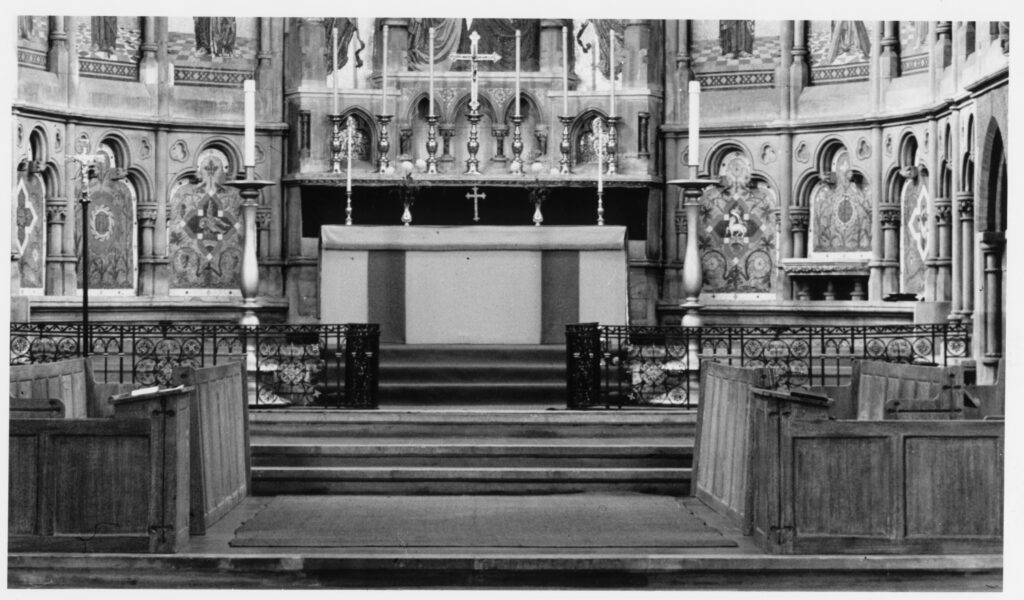
The original alter at St. Luke's
The First World War saw thousands of men from the area enlist for the services. Too many did not come back. It is a testament to the poverty of the area that when the memorial was erected there was not sufficient funds to inscribe the names of those who ied for their country on it – perhaps there were too many?
War and Re-development
History took another brutal turn for Canning Town in September 1940 when the docks and surrounding factories were the focus for the worst aerial bombardment Britain saw. Civilian casualties were highest around London’s docks and the worst single incident was the Hallsville School tragedy in September 1940 when many mothers and children died waiting for their evacuation bus which had mistakenly gone to Camden Town rather than Canning Town.
The bombing had destroyed swathes of housing – up to 85% of the houses around the docks area. Despite the national housing shortage it was decided that the majority of the remaining slum areas should also be demolished.
The policy to build a better future was put into effect in 1948 with the building of the Keir Hardie estate consisting of solid houses and blocks that remain perfectly serviceable today. The rest of the redevelopment was postponed until the 1960s when the new A13 was cut through the community and when the industrial building boom was at its height.
During this time, some of London’s worst post war housing was built. Prefabricated housing blocks including the 22-story Ronan Point and its eight “sister” blocks named after local Councillors of the time, were thrown up. In 1968 a gas explosion in Ronan Point led to a partial collapse of the building killing 14 people. This spelt the end of post war high rise building by councils. Social problems in the blocks blamed on the architecture led to the demolition of the blocks from the late 1980’s onwards.
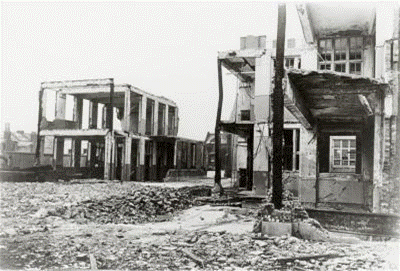
Hallsville Road September 1940
Decline and Abandonment
Canning Town had always been a notoriously poor area but there had been work and this had attracted more immigrant labourers off the ships to work in the docks and factories.
An early multi-racial working community had developed as is the case with other dock areas around the country. However, this world came crashing down with the closure of the docks from the mid 1970’s and its move to container-based shipping based outside of London. The life blood ebbed from the area and economic decline set in.
Institutions abandoned the area including the Church of England – St. Luke’s Church itself was largely un-used by the 1980’s and abandoned by 1985. In 1986 Canning Town became a deep pocket of deprivation and what is now called under-achievement. In 1973 one of the first sites the Home office chose for its community development programme was Canning Town – there have been many initiatives since.
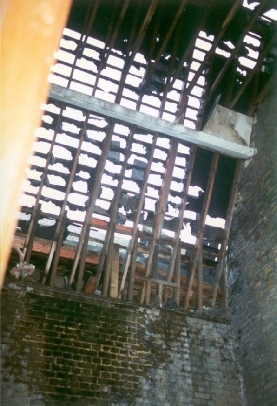
St. Luke’s before the Charity got hold of it in 1994. Click here for more images of St. Luke’s before the community saved it. Can you see the guano all over the place?
How the CH&CTCRP grew out of all this
When it was decided to demolish Ronan Point and its sister blocks from the mid 1980’s, local tenants groups combined to form the TWA group (after Taylor Woodrow Anglia who built the blocks) to insist that the land made available as the blocks were demolished be put to social use.
In 1992 an award winning “planning for real” exercise was undertaken to improve the local environment. Many interesting and novel ideas developed around the notion of the urban village and this was supported by Prince Charles. It was felt that the area lacked a range of social and commercial facilities.
Unfortunately, at the time the property market hit rock bottom and so there was no margin for planning gain. The land where the blocks once stood was crammed with more poorly built housing. The tenants fought on with their ideas and were finally given a 2 year grant to attempt to realise the opportunity that had been missed.
With this money the tenants established the Custom House and Canning Town Community Renewal Project (CH&CTCRP) in 1994. The aim then was to focus on area’s of dereliction with a plan to convert unwanted sites into socially useful spaces.
Given the short time available the group drew up 4 specific objectives and agreed to work on nothing else.
What the future holds
In recent times, exponential escalation of property prices has meant that there are far fewer abandoned plots of land and derilict buildings available to be converted for social use and social enterprise. However, we might find, as the present situation develops that the old approach becomes viable once more.
The opening of the Canning Town Jubilee Line underground station in 1999 led to a big increase in property values nearby. The new transport links attracted the interests of developers and with Council backing, plans to demolish 2,000 council built homes to make way for up to 10,000 high rise private apartments, went ahead. The area may become a more desirable location for some but unfortunately to make way for redevelopment the local people are being removed.
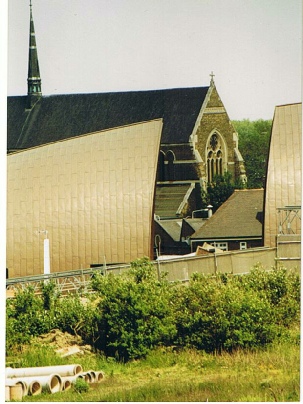
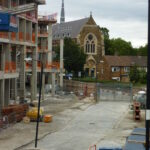
A changing view of St. Luke’s – in the foreground part of the Jubilee Line infra-structure